
Make or break decisions

Reflecting on yesterday’s post about logic bullying, I found myself questioning what gets me so charged up during such interactions. I most often don’t go in with an agenda to change anybody’s mind, so what accounts for the passion I work myself up to in a matter of minutes?

I realised that one key thing that spikes up my blood pressure during such disagreements is the narrowed view I get, as a result of the time and energy I have invested already in the back-and-forth arguments, that this decision is a make-or-break one. When in reality, barring a few instances in life, most of our decisions are not irrevocably life altering.

At such times, I have found that taking a step back and viewing the impact of the event relative to the sum of a person’s enter life experiences, calms me down almost instantly. Second, human beings have been proven to be bad at estimating the effects of their decisions on their future. We usually only see the benefits and fallouts from that one aspect of the decision, not the whole entourage that comes before, after or along with it. Also, I have come to realize that while we try to control what we can in life, there is a far bigger part that we can’t. Finally, from personal experience I know that in the long run, I have benefitted far more from my wrong decisions than I have from the right ones. The former teaches us lessons that we otherwise wouldn’t probably learn. So, why do I assume that it won’t be the same for others too?

The next time I get worked up in the process of convincing someone to not take a wrong decision, I will take a step back and ask myself: Is this really a make or break decision?
Don’t be a logic bully

I heard this term from organizational psychologist, Adam Grant. It is when someone throws a bunch of rational arguments to scare you enough to take what they think is the better decision in a situation. This is a misguided, however well intentioned, approach where they try to get you to arrive at the same conclusion as they did.

I am one of the people who is often guilty of this. What I really want to be is a guiding force to help the person make a well informed decision. Instead what I end up doing is beat them over the head with facts and figures and intimidate them enough to feel paralyzed and sorry that they asked me in the first place. They feel alienated and become warier of seeking my advice in the future. So I end up with the absolute opposite of what I wanted to achieve.

I have realized what helps instead, is to ask them to walk through their thoughts and rationale. Often when they are doing it, they will themselves acknowledge gaps in their planning. I could then present my thoughts and play devil’s advocate if needed. There is also the chance that they might show me a perspective that I had not even considered. Even if we end up disagreeing and they take a decision that I think could be wrong, I believe both parties still come out more enriched for having had the experience. We are each aware of a broader perspective, our bond of trust has strengthened and it could be a lesson in understanding how and why someone has a differing viewpoint – knowledge that we can harness to bridge the gap in future communications.

This is more of a reminder to myself. Don’t be a logic bully.

Parts of a whole

I was listening to the song Bharat from the movie Manikarnika – The Queen of Jhansi. It is composed by the dynamic troupe Shankar-Ehsaan-Loy, penned by Prasoon Jhoshi and sung in the dulcet tones of Shankar Mahadevan. My attention was seized by the first two lyrics that also form the chorus.

देश से है प्यार तो हर पल ये कहना चाहिए
मैं रहूँ या ना रहूँ, भारत ये रहना चाहिए

The lines translate to the following meaning.

If you love your country, then it should be said every moment
Whether I live or die, India should remain

These words capture the driving force behind every long-term movement, be it the fight for freedom, democratic protests against authoritarianism or a campaign to battle climate change. The people who lead and participate in these movements are guided by ideals bigger than any single person or group. They recognise the value of the whole over the individual. How else can they fight for something at risk to their own lives, depriving themselves of simple personal comforts, standing up to forces far stronger than their own, knowing all the while that their dreams may not be realised in their own lifetimes?

These contemplations tied together with another sonnet I read today, this time written by a 13th century Persian poet Sa’adi, whose words are woven into a tapestry that adorns the UN General Assembly hall.

Human beings are members of a whole
In creation of one essence and soul

Processes and Chinese Whisper

When any organization starts to grow, processes are inevitable. That is the only way to scale the team efficiently and continue to spend time on the important stuff. But with the advent of processes, comes the real danger of viewing the world through colored glasses. There are now multiple layers of abstraction between you and the situation on the ground. Every time a piece of information passes through another layer, it gets filtered further. And so, you find yourself in a real-life version of Chinese Whisper where the final version of the data bears little resemblance to the intention behind the original.

This is not because of willful manipulation by anyone. It is just the fallible nature of how we humans communicate. We add, remove and modify context based on our own experience and understanding. Some obfuscation is unavaoidable but there are some ways we can reduce the extent of it.

  • Define clear values for the organization. These are principles meant to guide and should not be confused with processes. They need to be reiterated and their meaning constantly diversified to fit changing times. A marker of a good value is one which doesn’t need to change but only expand in meaning with the passage of time.
  • Every time a process is introduced, talk about the intention behind it before laying out the metrics it is measured by. This is a very common pitfall that can lead a team to subconsciously alter the process so as to reach the target but at the cost of defeating the original purpose. For instance, downgrading the priority of an issue in order to meet SLA requirements, when in reality, we should be evaluating why the SLA breach happened, fix the root cause of the issue and put necessary systems in place to help the team meet the SLA.
  • As we go higher up the ladder, the more important it becomes to have a group of people who will tell us the honest truth. And the foundation for this is an open blameless environment. This is one of the hardest things to achieve.
  • Never get complacent with our own sense of morality. When you stop questioning yourself on ethical dilemmas, that is when you slowly start wearing blinkers.
  • And finally, the seed that drives all these steps – a profound wish to better oneself each day after day.

Unglamorous inspiration

The acts that galvanize me the most are the ones that are done quietly with no fanfare. Those people keep their head down, concentrate on what they are trying to accomplish and keep working at it. When we hear someone has passed a difficult exam or realized a long-term dream, we are immediately inspired. But what we watch with awe is only the final result. What is hidden is the steady and disciplined effort that went into it – rallying against obstacles and doubts, failing and trying again, dealing with the mundane (often boring) daily preparation, fighting distractions and so much more. All this happens in the background while the people around them are caught up in their own lives.

Those banal pedestrian parts of a person’s journey… that is where the real lessons lie.

The gap in problem-solving

Whenever a problem arises in life, there is a period of time between then and the point when we accept it. That is the interval during which we battle with denial and anxiety. Once we have acknowledged the situation, we will begin to formulate possible action steps and proceed to act on them. And then this cycle will continue with each stage of the issue and every failed attempt to resolve it.

Neither problems nor obstacles while resolving them are completely avoidable. What we can aim to reduce is this gap. By battling negative emotions like fear, building courage and improving our problem-solving approach and skills.

The stopwatch

I landed upon a very useful environmental reinforcement for habit building in an unlikely moment of inspiration, if I may say so myself 😉 It happened when I was trying to resume my habit of reading non-fiction books last year. For every 5 minutes I read, I would spend the next 20 browsing my phone. It was an unconscious motion, my hand would already be unlocking the device before my brain caught up to what I was doing.

That is when I got this genius idea. I set a stopwatch on my phone for one hour. Every time I reached for the phone, I would see the timer on the home screen and my finger would pause. It worked beautifully! After the first 15 minutes, I realised that I had not checked my phone in 5 minutes and by the end of an hour, I was immersed enough to increase the timer by another 60 minutes.

I did this often until one day I noticed that I had not needed the support in order to settle down with a book in the past few weeks. Environmental reinforcements and deterrants are simple yet powerful ways to shape habits. I learnt about them a few years back in a book written by the Heath brothers, Switch. The lesson continues to serve me in good stead till date.

Mindset

A shift in mindset changes the lens through which we view life. And once you see it that way, you can never un-see it. The effects last for life. And therein lies the true power of mindset shifts.

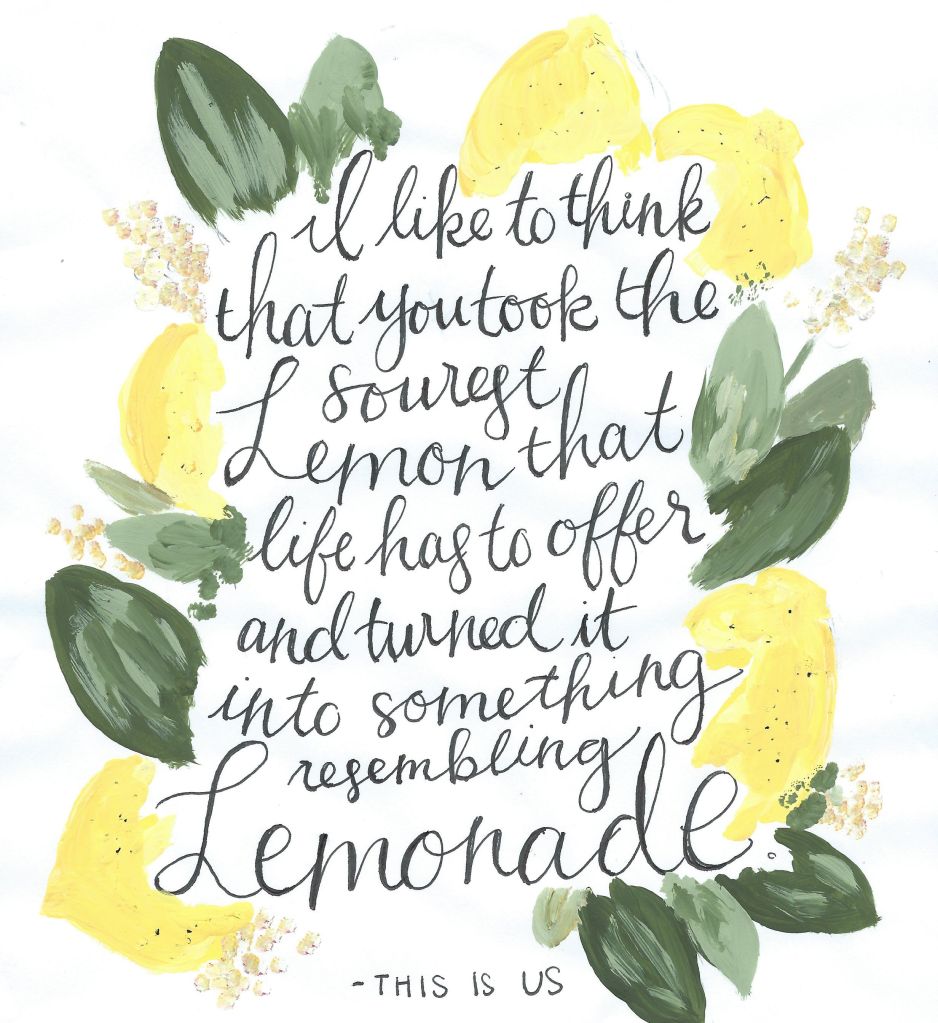
Lemons to lemonade

This is Dr. K’s iconic quote from the TV show, This Is Us. If you have not watched the first couple of episodes, be warned, there are spoilers ahead!

Jack, a very enthusiastic and optimistic father-to-be, has just come out of his wife’s delivery room where she gave birth to triplets, of who, one didn’t survive. Dr. K takes a seat next to him and narrates his life story – how his wife losing their first child propelled him to become an obstetrician, enabling him to save hundreds of other babies. And then he proceeds to give him this memorable life lesson.

Jack realizes the lesson that same day when he comes across a third baby lying next to his own kids in the NICU. The infant had been brought in by a firefighter who had found him left in a blanket outside the fire station. Jack came to the hospital that day vowing to take three babies home and he keeps his promise. It is a heart warming depiction of loss, love and hope.

When life throws hardships at us, it is not immediately clear how we can take control. We have to look for it. By stepping out of our own misery, empathising and most importantly, searching for purpose. That is how you make the sourest lemons into something resembling lemonade.