Courage in everyday moments

I was recently listening to this interview of Erika Cheung by Maya Shankar on her podcast A Slight Change of Plans. When asked how she was able to take the step to call in Theranos on their unethical practices despite the legal ramifications, the global Theranos bandwagon and her own doubts, she said this.

(paraphrased)

The idea of knowing what I knew and having not done anything… , and I didn’t do anything, like, that’s the real prison, right?… . Like, that’s the real purgatory, right.? To sit with yourself and to realize that you didn’t push it forward. So it just… for me, that that was a much worse reality.

Opportunities for courage don’t come in black-and-white moments with crystal clarity of right vs wrong. Neither do they come in the backdrop of majority support. Rather they live in those fuzzy every day phases of life when we have a vague inkling of something violating our principles. If we don’t speak up, it is just another day / month / year that the wrong lives on. It’s how slavery and sexual harassment survived for so long.

What differentiates those who speak out from the rest is that they question – the facts, assumptions, ethics – and they don’t fear the answers.

Incremental over perfect

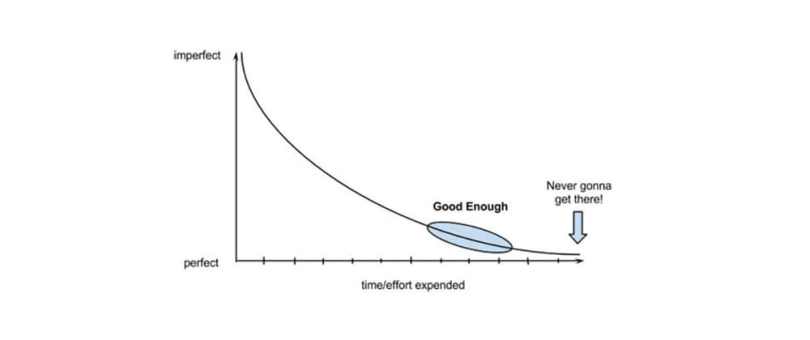
Don’t let perfect be the enemy of good. A lesson that has been consistently reinforced in my recent professional life.

When embarking on a new project for which we have a vision of the end result, use that image as a guide to correct for the big picture along the way but don’t fixate on it.

Build a minimum viable prototype.

Share regularly with others – the feedback we receive can lead to crucial pivots.

Be open and adapt to changes that are aligned with the overall purpose. It is okay to take a few wrong detours, they will be good teaching moments for the future.

It is never about this one project but the learning that will feed into all our future ventures. The journey is more important than the destination.

Incremental growth is how we get from good to great. It is not achieved in a single shot.

Better than more

When I was young, my mom told me to look at my watch without any distraction for 60 seconds as the minute hand completed one full cycle. That was the day I learnt to appreciate the value of time.

Looking back, I can see there was another teaching moment there. To appreciate any intangible aspect of life, we often think we need to do more of it. Instead what’s needed is to slow down and single it out from other distractions. That is how we can grow to comprehend its worth.

When we truly understand its value, we will use it better instead of more.

Implications of fear

The only thing we have to fear is fear itself.

– Franklin D. Roosevelt

Fear distorts perspective and robs us of clarity, without which we cannot be good decision makers.

Setting aside our fears will free us to use all our tools – sensibility, facts, advice, experience, instinct – in order to take action with a clear and calm mind. Even if the decision proves to be wrong, we will have the mettle to accept and recover from it. On the other hand, when we choose because of fear, it will keep us from reaping the benefits even if the choice was right.

Fear and clarity can never travel together.

Inclusion

Shaming women who lose weight when we are advocating against body image.

Shaming home makers when advocating for women in the workplace.

Being inclusive of one group can never come at the cost of shaming another. We cannot create true understanding of what “inclusion” and “acceptance” mean until we demonstrate by example what embracing and love look like.

Inclusion has to leave room for a broader meaning in the future. “We embrace you” is inclusion. “We embrace only you” is just yet another divide – bigger and looming in the morrow.

This is a good thumb rule for an inclusive mission statement or principle. It will be able to evolve to accept more tomorrow. If it needs to be broken, then it was never right in the first place.

Infusing light

When trying to improve the intrinsic (not materialistic) quality of our lives, we tend to usually focus on our problem areas and come up with strategies to address them. While this is crucial for us to evolve as better people day over day, they can sometimes make us too singularly focused.

What helps to have alongside such serious goals is to seek out people and experiences that invoke curiosity, excitement and just pure joy.

Going to your favorite concert. Exploring a new city. Learning a new hobby. Having a party.

These experiences can infuse light to permeate darkness in a way that nothing else can.

Notes from Dan Ariely

Recently came across this ALearningADay post containing notes from an interview with Dan Ariely. The following points particularly resonated.

  • A behavior that is hard to get over is to develop the courage to express your true opinion in a world that values political correctness. How can we as leaders encourage people who will disagree with us?
  • Experiments teach us humility.
  • Failing in a magnificent way means you tried, failed and learnt.
  • Ethics are expensive. I think a lot about my own conflicts of interest. There is no easy answer.
  • We are privileged to live long. Think of life as an opportunity for continuous learning.

A common theme here is continually questioning our own actions, principles and assumptions. As long as we do that, we will never cease to learn and grow.

Hindsight bias

I thought that this might happen…

Why didn’t you plan for this variable?…

I told you so…

These are common phrases used retrospectively after an unexpected event occurred or something went sideways despite planning.

This is easy to say. After all, hindsight is 20-20.

But what do we achieve by it?

Nothing except self-absolution from responsibility and blaming ourselves or another person for things that we often have no sway over. This is just retrospective talk, not retroactive.

What’s more useful is forgiving ourselves. Accepting that some things are out of our control. Embracing the opportunity to gain new knowledge. If we keep sight of the end goal and continue adapting to the circumstances, we can still emerge better for the situation.

Blaming for mistakes based on hindsight bias will keep us from learning from them.

Forgive first-time errors so we can avoid second-time repeats.